Complete Guide to Restaurant Seat Numbers in 2026
Complete Guide to Restaurant Seat Numbers in 2026 starts with a problem most operators underestimate: a 60-seat dining room can turn chaotic fast if servers, hosts, runners, and POS screens use different numbering logic. One skipped seat position at a four-top can ripple into wrong food drops, split-check errors, and slower table turns all night.
I’ve worked with restaurants that had beautiful floor plans but sloppy seat mapping, and the result was always the same—communication broke down at the busiest hour. Get seat numbers right, though, and you make service tighter, training faster, and guest recovery much easier.
How we select products and systems: Our team reviews restaurant workflows daily, analyzing floor-plan logic, server usability, POS compatibility, durability standards, buyer feedback patterns, and pricing tiers to surface options that deliver real operational value. We prioritize systems and supplies that reduce order errors, hold up to heavy service, and stay readable in low-light dining rooms.
Best Restaurant Table Numbers for Cafes and Dining Rooms in 2026 #
We researched and compared the top options so you don’t have to. Here are our picks.
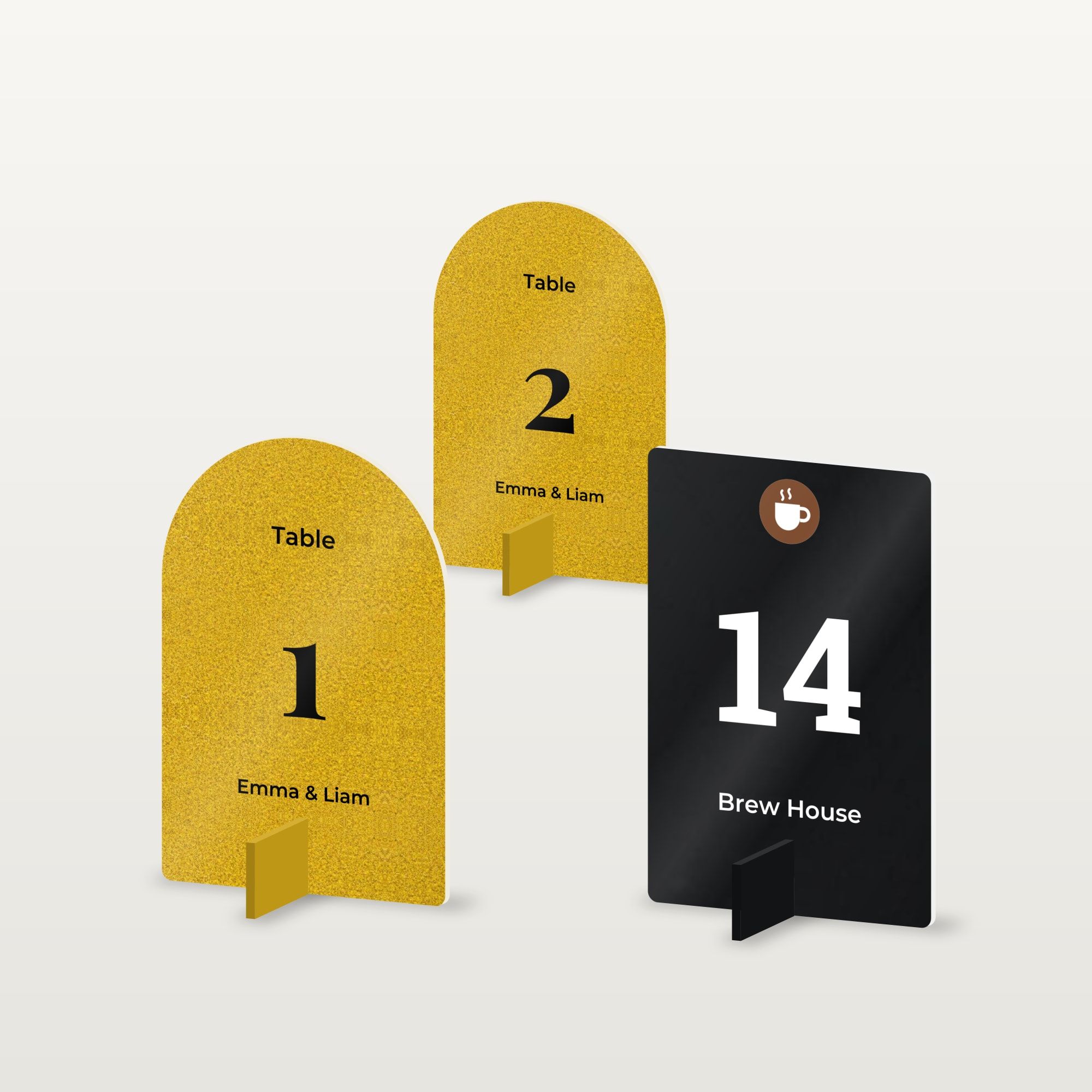
#1 — Custom Acrylic Table Numbers with Stand – Personalized Wedding & Restaurant Table Number Signs #
by Table Numbers
- ✅ Sure! Please provide the specific product features you’d like me to focus on for the sales highlights.

#2 — Tuanse Table Numbers 1-25 Acrylic Double Sided Table Tents, Red, White | Plastic Restaurant Numbers Cards Signs Holders for Party Banquets Wedding Reception #
by Tuanse
- ✅ Piece Set**: Enough bold table numbers for any event’s needs!
- ✅ Easy to Read**: Clear from any angle with eye-catching design!

#3 — Restaurant Table Numbers 1-25 White, Tent Table Numbers (3 in x 3.5 in) #
by Tapix
- ✅ Quick Guest Seating** - Double-sided tents help guests find seats fast.
- ✅ Durable and Shatterproof** - High-quality plastic ensures long-lasting use.

#4 — Tuanse 1-30 Table Order Numbers,Restaurant Double Sided Acrylic Sign, Black | Restaurant Reception Number Stands, for Wedding Seating Cafes Party Banquet #
by Tuanse
- ✅ Versatile: 30 durable acrylic numbers perfect for any event!
- ✅ Clear Visibility: Double-sided design ensures easy readability from afar.
- ✅ Space-Saving: Lightweight size enhances decor without crowding tables.

#5 — Okllen 1-30 Table Numbers Red, Restaurant Acrylic Order Numbers, Double Sided Table Number Card Signs for Wedding Party Seating Cafes Banquet #
by Okllen
- ✅ Versatile Use**: Perfect for events, restaurants, and coffee shops.
- ✅ Durable Design**: High-quality acrylic ensures lasting use and easy care.
- ✅ Eye-catching Visibility**: Bright red backgrounds for easy reading from afar.
What is the Complete Guide to Restaurant Seat Numbers in 2026 really about? #
At its core, the Complete Guide to Restaurant Seat Numbers in 2026 is about standardizing how your team identifies every guest position and every table in the room. That includes restaurant table seat numbers, table naming conventions, seat rotation rules, and the physical markers you use for table numbers restaurant operations.
The best modern setup uses two layers of numbering:
- Table number: identifies the furniture location in the dining room
- Seat number: identifies the guest position at that table
That distinction matters. Table 24 Seat 3 tells a server, expo, and manager exactly where an appetizer, allergy meal, or check presenter should go. “The guy in the blue jacket” does not.
Why restaurant seat numbers matter more in 2026 than they did five years ago #
Restaurants now rely on tighter integrations between handheld ordering, kitchen display systems, runner screens, and reservation notes. If your numbering is inconsistent, the tech can’t save you.
A good numbering system typically improves:
- Order accuracy
- Seat-specific food delivery
- Split payment speed
- New-hire training time
- Guest note tracking, especially for allergies and celebrations
In full-service restaurants, the single best practice is this: seat numbers should always rotate in one consistent direction from a clearly defined Seat 1 position.
How do restaurant seat numbers work in a real dining room? #
Most restaurants assign Seat 1 based on a fixed reference point. That reference point is usually the seat closest to the main aisle, the entrance view, or the left-most seat from the server’s primary approach.
From there, numbering usually moves:
- Clockwise, which is the most common standard
- Or counterclockwise, if that’s already hardwired into the POS and training
The strongest recommendation for 2026: use clockwise numbering unless you have a documented reason not to. It matches the workflow most teams learn fastest and reduces “where does Seat 1 start?” confusion during rush periods.
Example seat map for common table sizes #
| Table Type | Recommended Seat Start | Numbering Direction | Best Use Case |
|---|---|---|---|
| 2-top | Seat nearest aisle | Clockwise | Fast casual, bistro, cafe |
| 4-top square | Seat facing entrance or aisle | Clockwise | Standard full service |
| 6-top round | Seat nearest main service lane | Clockwise | Family dining, events |
| Banquette + chairs | Left-most guest from server approach | Clockwise | Narrow floor plans |
| Bar seats | Left to right from service well | Linear | Cocktail-led service |
For round tables, consistency matters more than theory. I’ve seen teams waste minutes debating orientation on an eight-top; the winning system was simply “Seat 1 always faces the kitchen pass.”
What table numbering system works best for restaurants in 2026? #
The best table numbering system is the one a new hire can understand in under 10 minutes. That rules out random layouts like Table 4 beside Table 19 and Table 6 across the room.
The strongest setup is zone-first numbering:
- 100s for dining room one
- 200s for patio
- 300s for private dining
- 400s for bar/high-top section
This is why many operators search restaurant table numbers 1-100 or restaurant table numbers 1 100—they want a numbering framework that scales cleanly. If you run one room only, simple sequential numbering works. If you run multiple service areas, zone-based numbering is better almost every time.
Best numbering models by restaurant type #
Small dining room: sequential 1-30 #
Best for restaurants under roughly 40 seats. It’s easy to memorize, easy to label, and ideal if one host stand controls the whole room.
Medium dining room: grouped by section #
Best for restaurants in the 40-120 seat range. Tables 1-10 might be front dining, 11-20 the window line, and 21-30 the patio.
Large operation: zone coding #
Best for restaurants over 120 seats or with event space. The clarity of 214 versus 38 becomes obvious during peak service, especially for runners and support staff.
For visual inspiration on display styles, some operators compare options through resources like Topdealsnet before choosing a format.
Complete Guide to Restaurant Seat Numbers in 2026: what to look for in numbering supplies #
If you’re buying physical markers, legibility beats aesthetics. Fancy fonts, reflective finishes, and tiny acrylic pieces look great in daylight and fail badly in dim service.
Here are the five most important criteria for table numbers for restaurant use:
Character height of at least 2 inches
Anything smaller becomes hard to read from 12-15 feet away, especially for runners carrying trays.High contrast
Black on white, white on matte black, or dark engraving on light wood performs best. Low-contrast gold-on-clear styles cause the most reading errors.Stable base or weighted holder
Lightweight signs tip easily when guests move plates or menus. This matters most for restaurant table tent numbers and patio seating.Water and chemical resistance
Daily sanitizing wears out cheap print coatings fast. If numbering fades within 3-6 months, replacement costs pile up.POS-friendly naming
Your physical marker should match the exact table label in the system. “Patio 7” on the POS and “P-07” on the table is manageable; “Sunset Table” is not.
The best-performing materials are usually engraved plastic, sealed metal, and wooden restaurant table numbers with a protective finish. Wood looks warmer, but it must be sealed properly to survive repeated wiping.
Which price bracket makes the most sense for restaurant numbering? #
Most operators don’t need the cheapest option. They need the lowest-cost option that stays readable after hundreds of cleanings and still looks organized during service.
Best budget options: simple sets for under-stress environments #
Budget numbering works best for:
- Cafes
- Counter-service rooms
- Pop-ups
- Seasonal patios
Look for:
- Printed or laminated number cards
- Simple holders
- Easy replacement packs
- Basic restaurant table numbers template systems you can update in-house
This is also where many owners browse restaurant table numbers amazon listings. The convenience is real, but quality varies wildly, so prioritize review consistency over appearance.
The sweet spot: mid-range sets for everyday service #
This is the best bracket for most full-service restaurants. You get stronger bases, cleaner typography, and finishes that survive constant handling.
If you’re buying table numbers restaurant supplies for a 50- to 100-seat room, the sweet spot is usually durable, standardized signage rather than decorative pieces. Function first. Style second.
Premium picks: best for branding-heavy dining rooms #
Premium numbering makes sense when the table marker contributes to the room’s visual identity. Think custom engraving, heavier bases, or bespoke finishes.
That said, premium is only worth it if the numbers stay instantly readable. The best luxury option is still the one a food runner can identify in two seconds.
For style comparisons, some restaurants also review design-focused sources such as Railway and https://dashai.ghost.io, especially when evaluating acrylic formats for private dining or event crossover use.
What are the best restaurant table numbers ideas for faster service? #
The best restaurant table numbers ideas combine visibility, logic, and speed. If a concept looks clever but slows down food running, it’s the wrong idea.
Top recommendations by use case #
Best for speed: tall, double-sided table markers #
Tall restaurant table numbers are the best pick for busy dining rooms because runners can spot them above water glasses, condiment caddies, and floral pieces.
Best for compact spaces: edge-mounted or clip-style numbers #
These keep surfaces clear on two-tops and bar ledges.
Best for branding: engraved wood or matte metal #
Unique restaurant table numbers can elevate the room, but only if they don’t sacrifice contrast and font size.
Best for turnover-heavy restaurants: laminated inserts with replaceable holders #
These are cheap to update and ideal if you frequently reconfigure sections.
💡 Did you know? #
A number displayed on both sides of a table marker is usually easier to identify from at least two service lanes, which can cut hesitation for runners approaching from different angles.
What the reviews say: red flags that cause numbering problems #
The most common failure pattern isn’t “ugly numbers.” It’s unreadable numbers during peak service.
Watch for these red flags:
- Glossy finishes that reflect pendant lighting
- Thin script fonts that blur from a distance
- Bases too light for outdoor or fan-cooled spaces
- Non-standard labels that don’t match the POS
- Decorative themes instead of numbers, which slow down training
I’ve also seen problems with restaurant table order numbers being confused with table IDs. If you use buzzers, kiosks, or pickup stands, keep dine-in table numbers visually separate from order pickup numbers. Different color bands work well.
For broader comparisons of layout guides and adjacent display formats, some readers cross-reference resources like see original and visit site, though your final decision should always be based on restaurant workflow, not décor alone.
How to memorize restaurant table numbers without slowing down training #
The fastest way to learn a floor is by zone + anchor + path. That’s the practical answer to how to memorize restaurant table numbers.
Use this training method:
Break the room into zones
Front, center, patio, bar, private, or window wall.Choose anchor tables
Start with obvious landmarks like the host stand, service station, or banquette corner.Walk the same route every time
Repetition matters. A clockwise lap builds recall much faster than random walkthroughs.Pair table number with seat 1 position
Don’t just memorize “Table 12.” Memorize “Table 12, seat 1 faces the aisle.”Quiz from photos or floor plans
Staff who study a printed floor plan for even 5 minutes before lineup usually learn faster than staff who only hear verbal explanations.
Pro tip: The easiest rooms to memorize use visible logic like odd numbers on one side and even numbers on the other. If your current map feels impossible to teach, the numbering system may be the real problem.
If you’re documenting your floor plan alongside other operational guides, lightweight workflow resources like here or ponddoc.com can help teams think about portable setup and documentation habits, though restaurant-specific diagrams should remain your main training tool.
Complete Guide to Restaurant Seat Numbers in 2026: should you use templates, tents, or custom signs? #
The best choice depends on service style.
Use a restaurant table numbers template if: #
- You’re opening soon and need quick deployment
- You expect section changes
- You’re testing layouts before ordering permanent pieces
A restaurant table numbers template is best for temporary flexibility. It’s not the final answer for a polished room, but it’s excellent for launch periods and soft openings.
Use restaurant table tent numbers if: #
- You need visibility on larger tabletops
- You run specials, events, or mixed-use dining spaces
- Your staff needs numbers visible from multiple angles
Restaurant table tent numbers are especially practical in banquet, brunch, and patio settings.
Use custom signs if: #
- Your floor plan is stable
- Your brand presentation matters
- Your lighting allows strong readability
The best long-term recommendation for most full-service restaurants is custom but simple: clean font, high contrast, durable base, and full POS alignment.
What is the single best setup for most restaurants? #
For most operators, the best setup in the Complete Guide to Restaurant Seat Numbers in 2026 is:
- Zone-based table numbering
- Clockwise seat numbering
- Double-sided, high-contrast table markers
- A documented Seat 1 rule
- Matching POS labels and physical signs
If you only change one thing, standardize Seat 1 across every table type. That one rule prevents more delivery mistakes than any decorative upgrade ever will.
Frequently Asked Questions #
how to memorize restaurant table numbers #
The fastest method is to learn tables by zone, then walk the room in the same path every shift until the pattern sticks. Pair each table with one visual landmark and the Seat 1 position so you remember both location and service order.
what is the best way to number restaurant tables? #
The best way is to use a logical sequence that matches the physical floor plan, usually by section or zone. For most restaurants, clockwise seat numbering and grouped table numbers reduce training time and order errors the most.
are restaurant table tent numbers worth it? #
Yes, especially in larger dining rooms, patios, and banquet setups where visibility from multiple angles matters. They’re most worth it when the print is high-contrast and the base is heavy enough to stay upright during service.
should I use restaurant table numbers 1-100 for a small dining room? #
Not usually. A small room works better with a short, simple sequence like 1-20 or 1-30, because staff recall is faster and guests aren’t confused by high numbers in a compact space.
what are the best restaurant table numbers ideas for full-service dining? #
The best ideas prioritize readability over decoration: tall double-sided markers, matte finishes, and numbering that matches your POS exactly. For full-service dining, clear table numbers for restaurant use will outperform themed or overly stylized designs almost every time.